Ti64 Material Properties

Compare Ti64 against common metals and other superalloys.
*Material data represents typical values for hardened states after solution annealing and aging, where applicable.
Strength-to-Weight Ratio
Ti64 provides an unmatched strength-to-weight ratio making it an ideal choice for high-performance structures where weight is important. It is the best choice of metal for many aerospace, medical, defense and performance racing applications.
Only composites such as carbon fiber exceed the strength per weight of Ti64 but those materials often lack the ductility, homogeneity and temperature stability of metals. Furthermore, additive manufacturing processes enable complex 3D geometries in Ti64 such as lattices and geometrically stiffened structures to optimize performance for a given application.
Thermal Stability
Ti64 retains strength for service temperatures up to 750° F (400° C). It also has a relatively small coefficient of thermal expansion making it well-suited for applications that need to retain dimensional tolerances across varied temperatures.
These thermal properties make Ti64 an exceptional candidate for housings in optical systems, for example. Camera bodies, lens bodies, optic mounts and other optomechanical components benefit from the exceptional strength per weight, thermal stability, geometric freedom and low-cost manufacturing offered by additively manufactured Ti64. This value proposition combined with Dr. Renshaw's decade of expertise in optical system development motivated the founding of Cadential Fabricators.
Thermal Treatments
Processing Standards
Thermal processing is defined and controlled per ASTM F2924 and SAE AMS2801D.
Thermal treatments are conducted in a TMAX GF14Q atmosphere furnace, which is capable of heating to 2,370° F under vacuum or inert gas atmosphere exceeding Class 2 (AMS2750) uniformity. Our standard thermal processes are conducted under vacuum to avoid hydrogen embrittlement and additional surface processing.
Our standard processes are described below. We can also perform non-standard processes (such as beta annealing, non-standard tempers, etc.) at customer request and/or to target desired mechanical properties.
Class A & E
Class A & E components are stress relieved (SR) by annealing in the heated build tank during the build process. Also referred to "as built" parts. These are not subjected to any additional post-build thermal treatments. They offer high strength (830 MPa), high ductility (15% elongation), and moderate hardness (Brinell 180).
Class B & F
Class B & F start as Class A (SR) but are further annealed at 1,300° F for a duration of 2 hours. Parts are then furnace or air cooled. This yields mechanical properties between the high ductility of Class A&E and the extremely high strength of Class D. They exhibit slightly higher strength and hardness, but reduced ductility than Class A & E. They also exhibit slightly lower strength and hardness, but increased ductility than Class D.
Class D
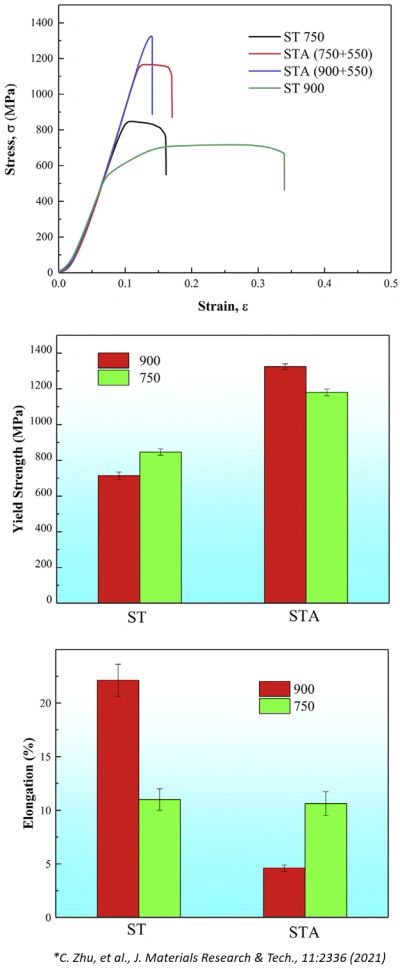
Class D starts as Class A (SR) but is then solution annealed, quenched and aged to yield a uniformly mixed alpha/beta phase that exhibits the highest strength. This is the most common choice for high performance parts and we offer Class D in two tempers that trade between strength and ductility. Solution annealing is performed at 1,750° F followed by water quenching with <7 seconds of air exposure.
- STA900 temper is aged > 8 hours at 900° F. This results in yield strength ~1,300 MPa and ductility of ~5%.
- STOA1300 temper is aged > 4 hours at 1,300° F. This results in yield strength ~900 MPa and ductility of ~10%.